
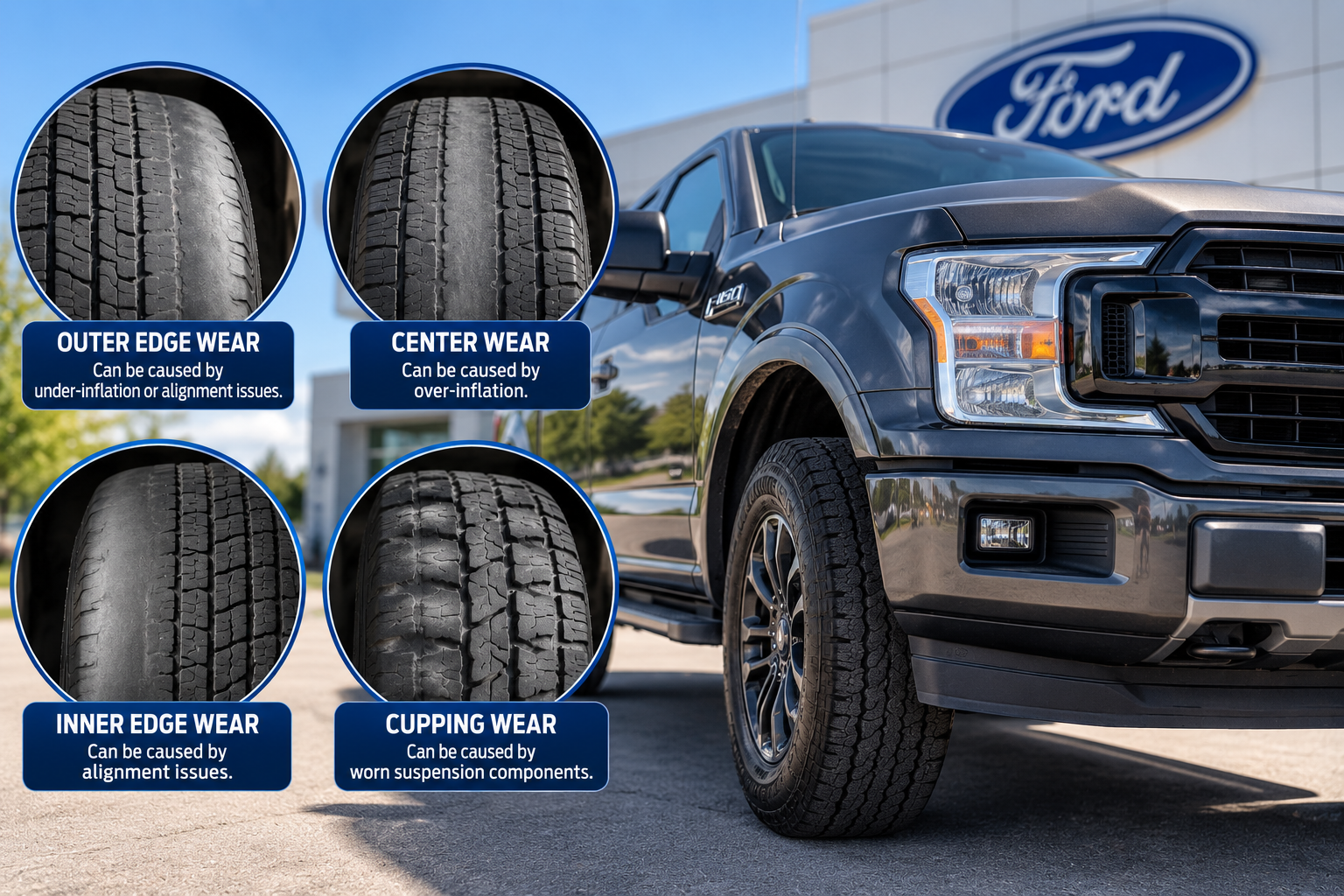
Uneven tire wear is one of the most common and most costly maintenance issues Yakima Valley F-150 owners face. Catching F-150 uneven tire wear early can save you hundreds of dollars on premature tire replacement. Here is your complete guide to what causes uneven tire wear, how to read tire wear patterns, and how to get professional tire service in Prosser at Speck Ford of Prosser. Why Uneven Tire Wear Matters Your tires are the only contact point between your F-150 and the road surface. Uneven tire wear reduces traction, handling, braking performance, and fuel economy significantly. It also dramatically shortens the overall life of your tires leading to premature and costly replacement. Addressing F-150 uneven tire wear early almost always means a less expensive repair than waiting until the problem becomes severe. Tire Wear Pattern Guide Wear Pattern What It Looks Like Most Likely Cause Center Wear Worn in middle, good on edges Overinflated tires Edge Wear Worn on both outer edges Underinflated tires Inner Tire Wear Worn heavily on inside edge Negative camber or alignment issue Outer Edge Wear Worn heavily on outside edge Positive camber or alignment issue Feathering Smooth on one side, sharp on other Toe alignment out of specification Cupping/Scalloping Dips or cups around tread Worn shocks or struts Patchy Wear Uneven patches around tire Tire balance issue or flat spot Common Causes of Uneven Tire Wear on a Ford F-150 Incorrect Tire Pressure Incorrect tire pressure is the single most common cause of uneven tire wear on any vehicle. Overinflated tires wear faster in the center of the tread. Underinflated tires wear faster on both outer edges. Always check your F-150's tire pressure when tires are cold and inflate to the recommended PSI on your door jamb sticker. Wheel Alignment Issues Wheel alignment problems are one of the most common causes of inner tire wear and outer edge wear on the F-150. When your wheels are not pointing in the correct direction, the tire scrubs against the road at an angle. Yakima Valley drivers who regularly travel rural roads or hit potholes on US-12 are especially susceptible to alignment issues. Tire Imbalance Unbalanced tires cause the wheel assembly to vibrate during driving creating cupping or scalloping wear patterns. Tire balancing should be performed every time new tires are installed and rechecked at regular intervals. Our tire service in Prosser at Speck Ford includes professional tire balancing on every rotation visit. Worn Shocks or Struts Worn shocks or struts allow your tires to bounce and hop during driving creating cupping wear patterns on your tires. If your F-150 has significant mileage and you notice cupping wear, have your shocks and struts inspected right away. Infrequent Tire Rotations Front and rear tires on your F-150 wear at different rates due to different driving forces on each axle. Most Ford service professionals recommend rotating your F-150's tires every 5,000 to 7,500 miles. Our tire service in Prosser at Speck Ford can handle your rotation during your next oil change visit. Signs You Should Have Your Tires Checked Your F-150 pulls to the left or right on a straight road You notice visible tire wear patterns that look uneven across the tread You feel vibration through the steering wheel at highway speeds on I-82 or US-395 Your ride feels rougher or bouncier than it used to on Yakima Valley roads You hear unusual humming or roaring noises from your tires during normal driving Your front tires are wearing noticeably faster than your rear tires between rotations How to Check Your Tire Tread Depth The Quarter Test Insert a quarter into your tread groove with Washington's head pointing down. If you can see the top of Washington's head, your tread is at or below 4/32 inch and replacement should be considered soon. The Penny Test Insert a penny into your tread groove with Lincoln's head pointing down. If you can see the top of Lincoln's head, your tread is at or below 2/32 inch. That is the legal minimum in Washington State and means immediate replacement is needed. Tread Depth Reference Guide Tread Depth Condition Recommendation 6/32 inch or more Good Continue regular maintenance 4/32 inch Fair Plan for replacement soon 2/32 inch Worn Replace immediately Below 2/32 inch Unsafe Do not drive on these tires How to Prevent Uneven Tire Wear on Your F-150 Check and adjust tire pressure at least once a month and before every road trip Rotate your tires every 5,000 to 7,500 miles or at every oil change visit Have your wheel alignment checked at least once a year or after any significant impact Have your tire balancing checked at every tire rotation and when installing new tires Inspect shocks, struts, ball joints, and tie rods at every major service interval Check your tires visually for unusual tire wear patterns at least once a month Get Professional Tire Service in Prosser at Speck Ford Ready to schedule your tire service in Prosser or alignment in Prosser at Speck Ford of Prosser? Our certified technicians use professional-grade equipment to diagnose and correct F-150 uneven tire wear quickly and accurately. Here is how to schedule your appointment: Online: Visit our website and click "Schedule Service" By Phone: Call our service department directly Walk-In: Stop by during service hours for same-day tire inspection Do not ignore uneven tire wear on your F-150. Schedule your tire service in Prosser at Speck Ford today and keep your truck performing safely on Yakima Valley roads. Schedule Service The information provided is for general informational purposes only and does not constitute legal, financial, or professional advice. While we strive to provide accurate and up-to-date information, we make no guarantees regarding the completeness, accuracy, or reliability of the information presented. Any action you take based on the context of this blog is strictly at your own risk. Always consult a qualified professional or specialist for advice specific to your situation. We are not responsible for any losses or damages arising from the use of this blog or its content.
Ford F-250 Gas vs Diesel: Which Makes Sense for Your Work?
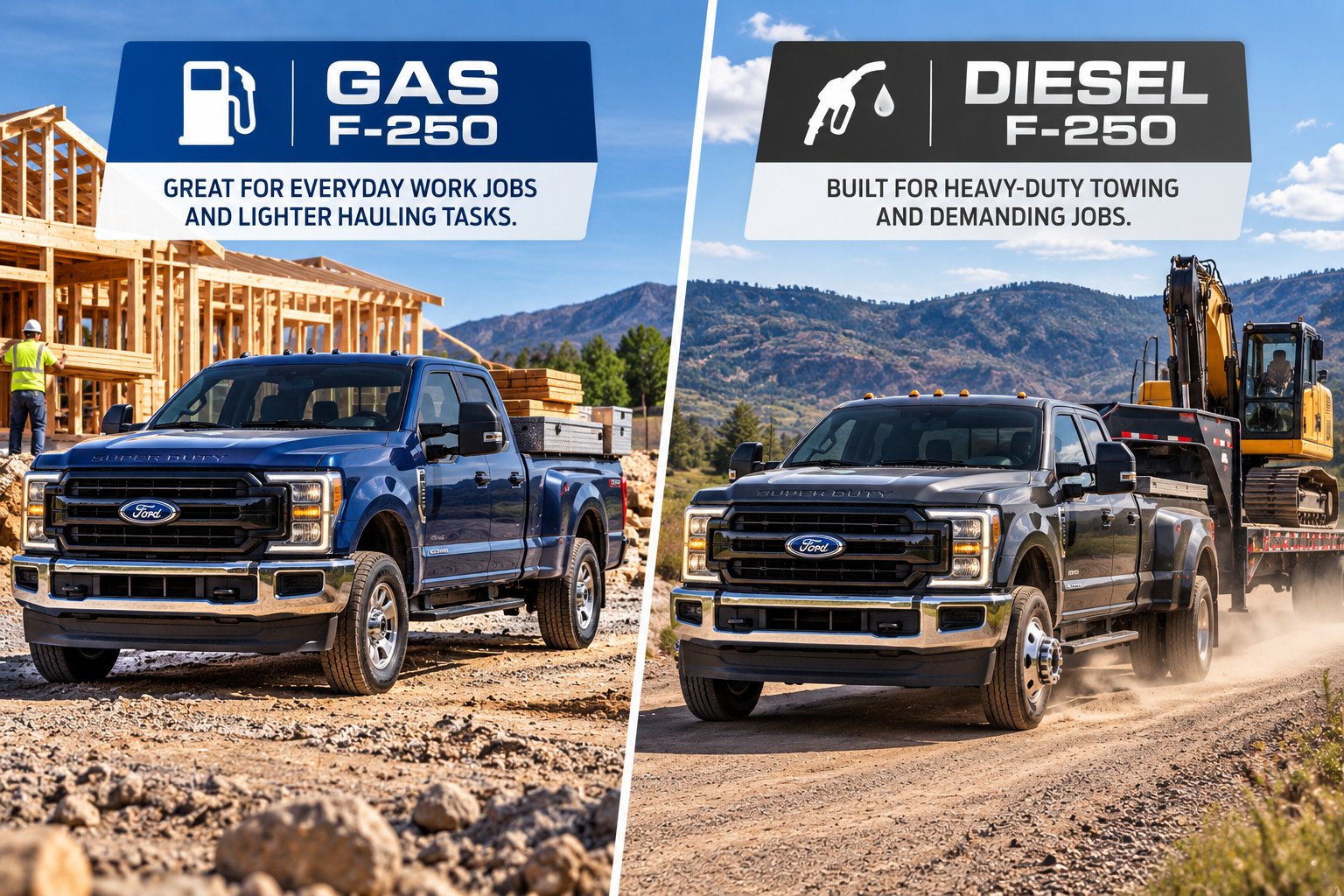
If you are shopping for a new F-250 for sale near Prosser, WA, one of the biggest decisions you will face is gas vs diesel. Both engines are proven, powerful, and capable of handling serious work across the Yakima Valley and Tri-Cities area. Here is your complete super duty gas vs diesel guide from Speck Ford of Prosser. F-250 Engine Options 6.2L V8 Gas: 400 HP · 464 lb-ft Torque · Standard Engine A proven and reliable workhorse at a lower upfront price than diesel. Simpler and less expensive to maintain over the life of the truck. 7.3L V8 Gas: 430 HP · 475 lb-ft Torque · Available Upgrade More power than the 6.2L without the diesel premium. A great middle-ground option for Prosser and Yakima Valley buyers who need more capability. 6.7L Power Stroke Turbo Diesel: 500 HP · 1,200 lb-ft Torque · Available Upgrade The most powerful and capable engine in the F-250 lineup. The clear choice for farmers, ranchers, and contractors who regularly push their truck to maximum towing capacity. Towing: Where Diesel Shines Engine Max Conventional Towing Max Fifth-Wheel Towing 6.2L V8 Gas 15,000 lbs 18,000 lbs 7.3L V8 Gas 17,500 lbs 20,000 lbs 6.7L Diesel 22,800 lbs 27,500 lbs The diesel engine's torque advantage is most noticeable during sustained heavy towing on long highway grades. Pulling a heavy fifth-wheel over Snoqualmie Pass or towing a livestock trailer across the Horse Heaven Hills is noticeably more relaxed with the diesel engine. Payload: Where Gas Has the Edge The diesel engine is significantly heavier than either gas option. That additional weight reduces your available F-250 payload capacity compared to an equivalent gas-equipped truck. Engine Max Payload Capacity 6.2L V8 Gas Up to 4,260 lbs 7.3L V8 Gas Up to 4,200 lbs 6.7L Diesel Up to 3,990 lbs If hauling maximum weight in the bed is a priority, the gas engine gives you slightly more available payload capacity for Tri-Cities job site work. Upfront Cost The 6.7L Power Stroke diesel option typically adds $10,000 or more to the purchase price of a new F-250. The 7.3L gas engine upgrade is a much smaller investment and provides meaningful power improvements over the standard 6.2L. Our team at Speck Ford of Prosser will help you evaluate whether the diesel premium makes financial sense for your work needs. Fuel and Maintenance Costs Diesel fuel is sometimes more expensive than regular gasoline at Prosser and Yakima Valley stations. However, the diesel's superior fuel economy on long highway hauls can offset the higher per-gallon cost for high-mileage drivers. Diesel engines also require more specialized maintenance including more expensive oil changes and regular diesel exhaust fluid (DEF) refilling. Gas engines are generally simpler and less expensive to maintain throughout their service life. Diesel-equipped F-250 trucks typically command a significantly stronger resale value at trade-in time. Which Option Is Best for Your Lifestyle? Yakima Valley Farmer or Rancher You regularly pull livestock trailers and heavy farm loads across Benton County and Eastern Washington. Your loads frequently approach or exceed 18,000 pounds behind the truck. Recommendation: 6.7L Power Stroke Diesel The diesel's massive torque and superior towing capacity make it the clear choice. Is a diesel truck worth it for this application? Absolutely yes. Tri-Cities Contractor or Builder You haul materials and equipment around Kennewick, Richland, and Pasco job sites every day. Your loads rarely exceed 15,000 pounds and you do mostly city and short highway driving. Recommendation: 7.3L V8 Gas The 7.3L handles typical contractor loads comfortably without the diesel premium. City driving and short trips do not favor the diesel's fuel economy advantage. Weekend Recreational Tower You tow a fifth-wheel camper or large boat on weekends with trailer weights between 16,000 and 22,000 pounds. You regularly travel to campgrounds and recreational destinations across Eastern Washington. Recommendation: 6.7L Power Stroke Diesel The diesel makes towing a heavy fifth-wheel noticeably more relaxed on long highway stretches. For loads over 18,000 pounds, the diesel is the safer and smarter choice. Light to Moderate Work Truck You need heavy-duty capability occasionally but most daily use involves lighter loads and everyday driving around Prosser and the Yakima Valley. Recommendation: 6.2L V8 Gas If your loads stay well within the gas engine's capability, the lower upfront cost and simpler maintenance make the most financial sense. Built for Tri-Cities Work From vineyard and orchard operations in Benton County to construction projects across Kennewick, Richland, and Pasco, the F-250 Super Duty is the workhorse of choice for Eastern Washington's hardest working drivers. Both gas and diesel options are fully capable of handling Tri-Cities area work demands. The right choice simply depends on the size and frequency of your loads. Find Your F-250 for Sale Near Prosser Ready to find your perfect F-250 for sale near Prosser, WA at your local Ford Super Duty dealer near Prosser? Our team knows every detail of both gas and diesel Super Duty configurations. Here is how to get started: Online: Browse our current F-250 Super Duty inventory at our website By Phone: Call our sales team directly to discuss your engine needs Walk-In: Stop by during business hours for a test drive and comparison We serve Prosser, Sunnyside, Grandview, Kennewick, Richland, Pasco, and the entire Yakima Valley. Your perfect F-250 for sale near Prosser is waiting for you at Speck Ford of Prosser today. Shop Ford Super Duty The information provided is for general informational purposes only and does not constitute legal, financial, or professional advice. While we strive to provide accurate and up-to-date information, we make no guarantees regarding the completeness, accuracy, or reliability of the information presented. Any action you take based on the context of this blog is strictly at your own risk. Always consult a qualified professional or specialist for advice specific to your situation. We are not responsible for any losses or damages arising from the use of this blog or its content.