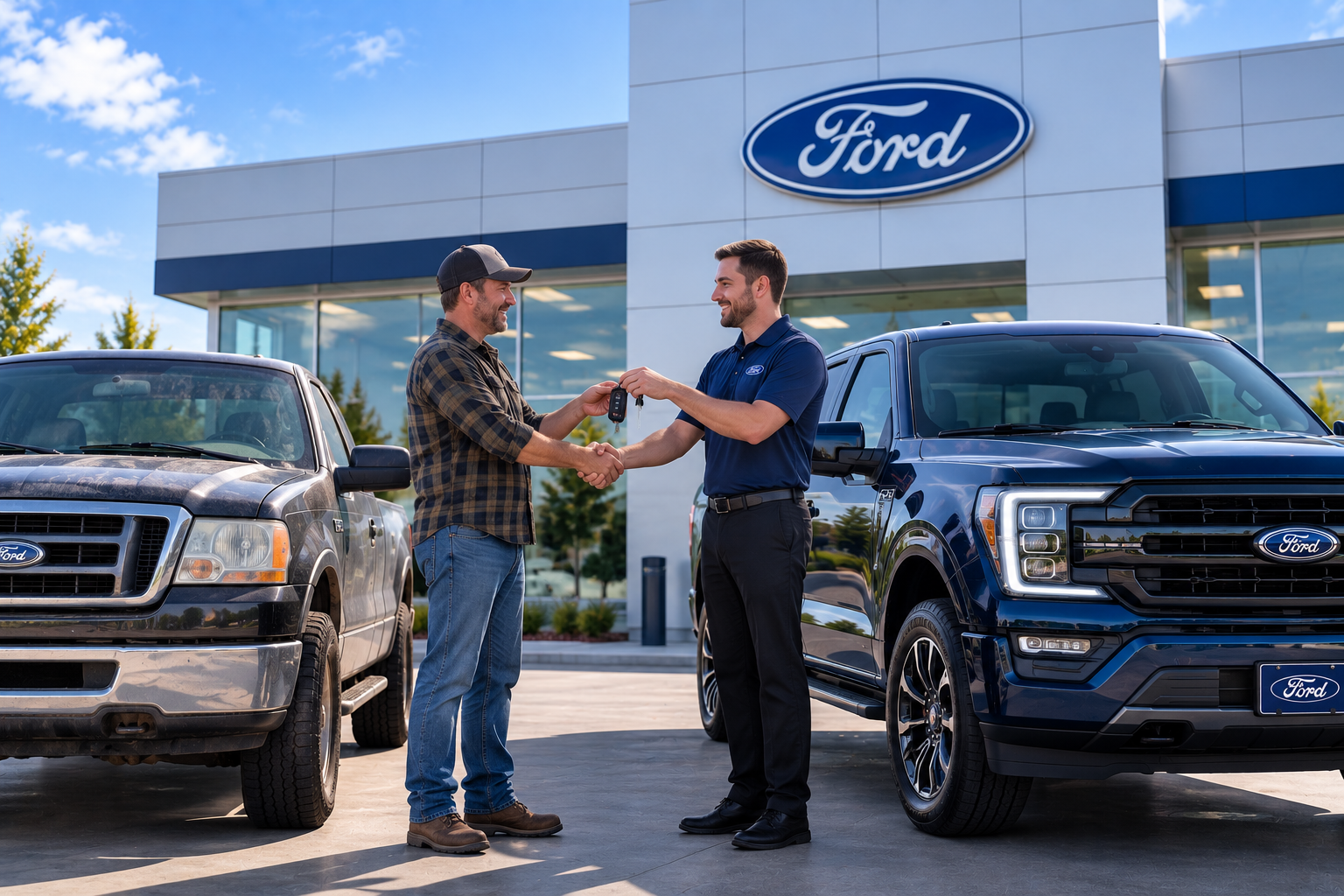
One of the most common questions our finance team receives at Speck Ford of Prosser is simple. Can you trade in a car you still owe money on? The answer is yes. Trading in a financed car is one of the most common vehicle transactions our team handles every single day. Here is a simple and straightforward guide to trading in a financed car near Prosser and the Yakima Valley. Can You Trade In a Car You Still Owe Money On? Yes. You can absolutely trade in a car you still owe money on at Speck Ford of Prosser. Having an existing car loan payoff balance does not prevent you from trading in your vehicle. Our finance team handles trade in a financed car transactions every single day for Sunnyside, Prosser, and Tri-Cities area drivers. The process is straightforward and our team will walk you through every step from start to finish. How Trading In a Financed Car Works: Step by Step Here is a simple breakdown of how the trade in a financed car process works at Speck Ford of Prosser: Step 1: Get Your Payoff Amount The first step is finding out exactly how much you still owe on your current vehicle. Contact your lender directly and ask for your current car loan payoff amount. The payoff amount is the exact dollar figure needed to completely pay off your existing loan. Make sure you get the payoff amount that is valid for at least 10 to 14 days to account for processing time. Your payoff amount may be slightly different from your current loan balance due to accrued interest. Step 2: Get Your Vehicle Appraised Bring your vehicle to C Speck Motors for a free no-pressure appraisal. Our team will evaluate your vehicle's condition, mileage, market demand, and vehicle history. We will present you with a real and competitive trade-in offer based on your vehicle's current market value. We also recommend getting a free Kelley Blue Book estimate at kbb.com before your visit. That gives you a solid baseline for understanding your vehicle's trade-in value before our appraisal. Step 3: Compare Your Trade-In Value to Your Payoff Amount Once you have both your trade-in offer and your car loan payoff amount, compare the two figures. Here is what the comparison tells you: Positive Equity If your trade-in value is higher than your payoff amount, you have positive equity in your vehicle. That positive equity can be applied directly toward the purchase of your next vehicle at Speck Ford of Prosser. Positive equity works just like a down payment and reduces the amount you need to finance on your next purchase. Negative Equity If your payoff amount is higher than your trade-in value, you are upside down on your car loan. Being upside down on a car loan means you owe more on your vehicle than it is currently worth. This is more common than most drivers realize and it does not necessarily prevent you from trading in your vehicle. Step 4: Handle the Payoff Our finance team at Speck Ford of Prosser handles the car loan payoff process on your behalf. We contact your lender, obtain the exact payoff amount, and arrange for your existing loan to be paid off as part of the transaction. You do not need to pay off your existing loan separately before trading in your vehicle. We take care of all the paperwork and coordination with your lender from start to finish. Step 5: Drive Away in Your New Vehicle Once all paperwork is completed and your car loan payoff is arranged, you drive away in your new vehicle. The entire process from appraisal to driving away can often be completed in a single visit to Speck Ford of Prosser. What Are Your Options With Negative Equity? Being upside down on a car loan is not ideal but it does not mean you are out of options. Here are the most common solutions for Yakima Valley and Tri-Cities drivers dealing with negative equity: Roll the Negative Equity Into Your New Loan The most common option for drivers who are upside down on a car loan is to roll the negative equity into the financing on their new vehicle. For example, if your trade-in is worth $20,000 but you owe $23,000, the $3,000 difference can be added to your new vehicle loan. Keep in mind that rolling negative equity into a new loan increases your monthly payment and total loan amount. Our finance team will show you exactly how negative equity affects your new loan payment before you commit to anything. Pay the Difference Out of Pocket If you have savings available, paying the difference between your trade-in value and payoff amount out of pocket is the cleanest option. Paying the difference eliminates the negative equity immediately and prevents it from carrying forward into your new loan. This option results in the lowest possible monthly payment on your new vehicle purchase. Wait to Trade In If the negative equity amount is significant, waiting until your equity position improves may be the smartest financial decision. Continue making payments on your current loan while your vehicle's value and loan balance converge over time. Our finance team at Speck Ford of Prosser can help you evaluate whether waiting or trading in now makes more financial sense for your specific situation. Choose a Less Expensive New Vehicle Choosing a lower-priced vehicle for your next purchase can help offset the impact of negative equity on your new monthly payment. A lower purchase price means a smaller overall loan amount even when negative equity is rolled in. Our team at Speck Ford of Prosser will help you find the right vehicle that fits both your needs and your budget given your current equity position. Washington State Trade-In Tax Credit Here is a significant financial advantage that many Yakima Valley and Tri-Cities drivers overlook when trading in a vehicle. Washington State offers a trade-in tax credit that can save you real money on your next vehicle purchase. Here is how it works: Your trade-in value is deducted from the taxable purchase price of your new vehicle before sales tax is calculated. For example, if you are buying a $35,000 vehicle and your trade-in is worth $10,000, you only pay sales tax on $25,000. At Sunnyside's sales tax rate of 8.2 percent, that trade-in tax credit saves you $820 in sales tax alone. At Kennewick's rate of 8.8 percent, the same scenario saves you $880. That trade-in tax credit is available only when you trade in at a dealership. It is not available when you sell your vehicle privately. The trade-in tax credit applies regardless of whether you have positive or negative equity in your vehicle. What to Bring When You Come In To make the trade in my car near Prosser process as smooth as possible, bring the following when you visit Speck Ford of Prosser: Valid government-issued photo ID for all titled owners of the vehicle Current vehicle registration confirming proper Washington State registration Vehicle title if you have paid off your loan and own the vehicle outright Your lender's name, account number, and current car loan payoff amount All keys, key fobs, and remotes for your trade-in vehicle Any available service records and maintenance documentation Ready to Trade In Your Financed Car at Speck Ford of Prosser? Ready to trade in my car near Prosser at Speck Ford? Our finance team is here to guide you through every step of the trade in a financed car process. We serve Sunnyside, Prosser, Kennewick, Richland, Pasco, and the entire Yakima Valley. Stop by or browse our current inventory online today. Come see us and let our team make your trade-in process simple, transparent, and stress-free. Get KBB Trade Value The information provided is for general informational purposes only and does not constitute legal, financial, or professional advice. While we strive to provide accurate and up-to-date information, we make no guarantees regarding the completeness, accuracy, or reliability of the information presented. Any action you take based on the context of this blog is strictly at your own risk. Always consult a qualified professional or specialist for advice specific to your situation. We are not responsible for any losses or damages arising from the use of this blog or its content.
Ford 4WD Modes Explained: Which Setting Should You Use?
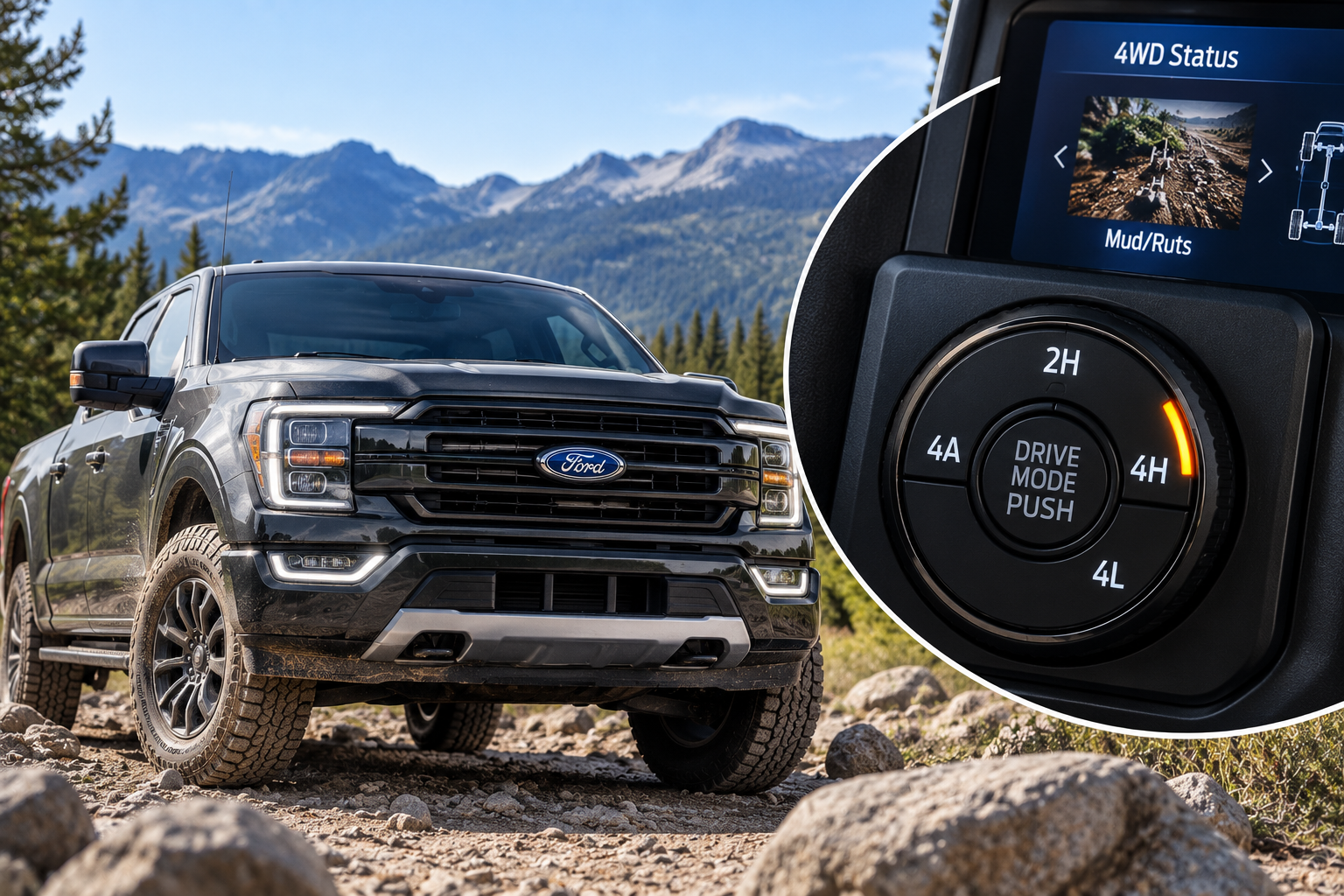
If you own a Ford F-150, Super Duty, Expedition, Bronco, or Ranger, you likely have access to multiple Ford 4WD settings. Many drivers are not sure which setting to use or when to use 4WD in different conditions. Here is your simple guide to Ford 4WD settings and Ford drive modes for Yakima Valley and Tri-Cities drivers. Ford 4WD Modes Explained 2H (Two-Wheel Drive High) 2H is your standard everyday driving mode. Use 2H for all normal driving on dry pavement around Kennewick, Richland, and Pasco. It delivers the best fuel economy of any available drive mode. Always use 2H on dry paved roads for the smoothest and most efficient everyday driving experience. 4A (Four-Wheel Drive Auto) 4A automatically engages four wheel drive when it detects wheel slippage or loss of traction. It switches back to two-wheel drive automatically when full traction is restored. 4A is a great everyday mode for Yakima Valley drivers who deal with variable road conditions. It is safe to use on any road surface including dry pavement without causing drivetrain damage. 4H (Four-Wheel Drive High) 4H sends power to all four wheels simultaneously for maximum traction in slippery conditions. Use 4H on snow, ice, mud, gravel, or wet roads at normal highway speeds. Most Ford vehicles allow you to switch into 4H while driving at speeds up to 55 mph. Do not use 4H on dry pavement as it can cause drivetrain binding and damage. 4L (Four-Wheel Drive Low) 4L provides maximum torque and traction at very low speeds for the most demanding off-road situations. Use 4L for rock crawling, deep mud, steep hill climbing, or getting unstuck. Always come to a complete stop before switching into or out of 4L. Yakima Valley drivers who explore the Horse Heaven Hills or Blue Mountains will find 4L invaluable. 4H vs 4L: Quick Reference Situation Best Mode Dry pavement everyday driving 2H Variable conditions throughout the day 4A Icy or snowy roads at normal speeds 4H Deep snow or mud at normal speeds 4H Rock crawling or extreme off-road 4L Steep hill climbing or descending 4L Getting unstuck from deep mud or sand 4L Ford Drive Modes Many modern Ford trucks and SUVs also offer selectable Ford drive modes that adjust throttle response, transmission shift points, and stability control for different terrain types: Normal: Standard everyday driving mode for balanced performance and fuel economy. Eco: Optimizes throttle and transmission for maximum fuel economy on long Yakima Valley highway drives. Sport: Sharpens throttle response for a more engaging driving experience on Eastern Washington highways. Tow/Haul: Always engage when pulling a trailer, boat, or camper across Eastern Washington highways and mountain passes. Slippery: Reduces throttle sensitivity for driving on wet, icy, or snowy road surfaces around the Tri-Cities. Mud/Ruts: Optimizes throttle and traction control for deep mud and rutted off-road terrain across Eastern Washington. 4WD vs AWD: What Is the Difference? Four-Wheel Drive (4WD) Four wheel drive is a driver-selectable system that locks all four wheels together for maximum traction. 4WD is found on trucks and body-on-frame SUVs like the F-150, Super Duty, Expedition, and Bronco. It provides the most capability in extreme off-road conditions. All-Wheel Drive (AWD) AWD automatically distributes power to all four wheels as needed without driver input. AWD is great for everyday winter driving and wet road traction. However, AWD generally cannot match the extreme off-road capability of a properly equipped four wheel drive system. For most Yakima Valley drivers, a 4WD truck with 4A mode provides the best of both worlds for everyday and off-road driving needs. Tips for Using 4WD in the Tri-Cities, WA Never use 4H or 4L on dry pavement as it causes drivetrain binding and damage Engage 4H before you need it rather than after you are already stuck or sliding Always slow down before switching between Ford 4WD settings on most models Come to a complete stop before engaging 4L on your Ford truck or SUV Use 4A as your default mode during variable Yakima Valley fall and winter weather Always return to 2H once you are back on dry pavement When to Use 4WD in the Tri-Cities Area Icy morning roads in Kennewick, Richland, and Pasco during winter months: use 4H Snow-covered roads heading over Snoqualmie or Blewett Pass: use 4H Muddy vineyard or ranch roads in Benton County and the Yakima Valley: use 4H or 4L Deep sand near the Columbia River or Eastern Washington recreational areas: use 4L Rock crawling on trails in the Blue Mountains or Cascade foothills: use 4L Getting unstuck from deep mud or snow drifts near Prosser or Sunnyside: use 4L Come See Our 4WD Ford Lineup at Speck Ford of Prosser Ready to experience Ford's impressive four wheel drive capability for yourself? Stop by Speck Ford of Prosser and our team will walk you through every available Ford 4WD setting and Ford drive mode on our current F-150, Super Duty, Expedition, Bronco, and Ranger lineup. Here is how to get started: Online: Browse our current 4WD Ford inventory at our website By Phone: Call our sales team directly to discuss your 4WD needs Walk-In: Stop by during business hours for a test drive and demonstration We serve Prosser, Sunnyside, Grandview, Kennewick, Richland, Pasco, and the entire Yakima Valley. Come see us today and experience the confidence of Ford four wheel drive for yourself. Shop Ford Inventory The information provided is for general informational purposes only and does not constitute legal, financial, or professional advice. While we strive to provide accurate and up-to-date information, we make no guarantees regarding the completeness, accuracy, or reliability of the information presented. Any action you take based on the context of this blog is strictly at your own risk. Always consult a qualified professional or specialist for advice specific to your situation. We are not responsible for any losses or damages arising from the use of this blog or its content.