

Speck Ford of Prosser

Blog / Automotive Service and Parts

Summer Car Care Tips from Speck Ford of Prosser

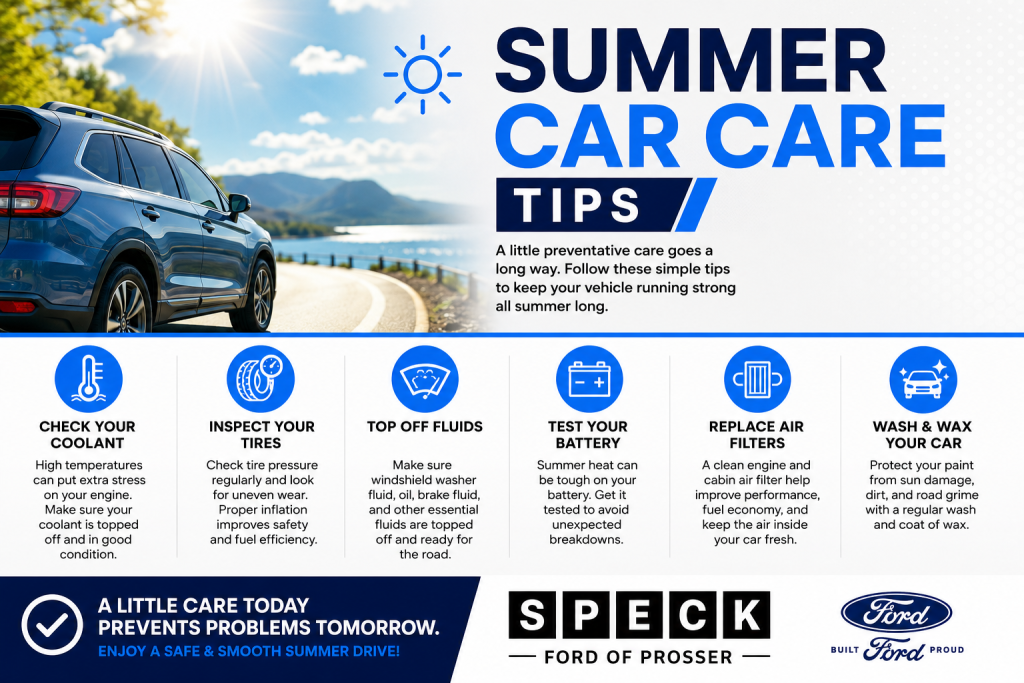
Summer in the Yakima Valley means triple-digit temperatures, long road trips, and vehicles that have to work harder than any other time of year. The good news is that a little proactive summer car care goes a long way and the team at Speck Ford in Prosser, WA is here to make sure your Ford is ready for everything summer throws at it. From routine maintenance to road trip prep, here's what to check before the heat peaks.

Important Summer Services for Your Ford

  • Oil Change: Motor oil breaks down faster in extreme heat, losing its ability to properly lubricate and cool your engine. If you're due for an oil change, or close to it, don't put it off heading into summer. Fresh, Ford-approved oil is your engine's first line of defense against the heat.
  • Coolant & Cooling System Check: Your cooling system works overtime in summer. Low or degraded coolant, a cracked hose, or a struggling water pump can lead to an overheated engine, one of the most common and costly summer breakdowns. Have your coolant level, condition, and hoses inspected before temperatures climb.
  • Ford Brake Service: If your brakes are squealing, grinding, or feel soft underfoot, summer is not the time to put it off. Whether you're driving mountain passes, towing a trailer, or just navigating busy summer traffic, worn brakes are a serious safety risk. Our Ford brake service team can inspect pad thickness, rotor condition, and brake fluid to make sure you're stopping confidently when it counts.
  • Battery Test: Most people associate dead batteries with winter, but summer heat is actually harder on batteries than cold weather. High temperatures accelerate battery fluid evaporation and internal breakdown. If your battery is more than three years old, have it tested before summer gets rolling.
  • A/C Service: Nothing makes a Yakima Valley summer more miserable than a struggling A/C. If your air isn't as cold as it used to be, or takes too long to cool the cabin, have your A/C system inspected and recharged before peak heat. It's one of the most requested summer services we see every year, don't wait until the hottest week of July.
  • Tire Check: Summer heat causes tire pressure to increase, raising the risk of a blowout on long highway drives. Check your pressure when tires are cold, inspect tread depth, and look for any sidewall cracking or bulging. Don't forget your spare.
  • Wiper Blades: Summer storms in Eastern Washington can arrive fast and hard. Worn, streaking wiper blades are a cheap fix that can make a big difference in visibility when a sudden downpour hits SR-12 or I-82.

Check our Ford Service Specials in Prosser, WA. We run monthly Ford service specials on everything from oil changes and tire rotations to brake inspections and A/C service. Before you schedule, check our current offers online. There's almost always a deal available that can save you money on what your Ford needs this summer.

What to Keep in Your Car This Summer

Even with a well-maintained vehicle, Eastern Washington's heat and remote stretches of highway make it smart to carry a few essentials. If something goes wrong between Prosser and the coast, these items can make a real difference:

Water

Keep at least a couple of bottles in the car at all times. Dehydration sets in quickly in Eastern Washington heat if you're stuck roadside.

Flashlight & Extra Batteries

Essential for roadside issues after dark. A compact LED flashlight takes up almost no space and is worth having every trip.

First Aid Kit

A basic first aid kit is a must for road trips, especially if you're heading into less-traveled areas around the Yakima Valley or Blue Mountains.

Phone Charger & Power Bank

A dead phone is a serious inconvenience on a remote stretch of highway. Keep a car charger and a backup power bank in your vehicle all summer.

Jumper Cables

A battery weakened by summer heat can fail without warning. Jumper cables, or a portable jump starter, can save you a long wait for roadside assistance.

Roadside Flares or Reflectors

If you need to pull over on a busy highway, flares or reflective triangles help other drivers see you, especially important on high-speed Yakima Valley roads.

Sunscreen

If you're ever stuck outside in Eastern Washington summer sun, sunscreen matters. Keep a small bottle in the glove box.

Tire Inflator or Fix-a-Flat

A compact tire inflator or a can of Fix-a-Flat can get you to the nearest service center when a slow leak or minor puncture hits on the road.

Summer is one of the best times of year to be driving in the Pacific Northwest

A little preparation goes a long way toward making sure every trip goes smoothly. The Ford service team at Speck Ford in Prosser is ready to help get your vehicle summer-ready with fast, professional service and current Ford service specials to keep costs down.

Schedule your summer service appointment online or stop by. We'll get you in, get you taken care of, and get you back out on the road.


The information provided is for general informational purposes only and does not constitute legal, financial, or professional advice. While we strive to provide accurate and up-to-date information, we make no guarantees regarding the completeness, accuracy, or reliability of the information presented. Any action you take based on the context of this blog is strictly at your own risk. Always consult a qualified professional or specialist for advice specific to your situation. We are not responsible for any losses or damages arising from the use of this blog or its content.
Posted in:

Related Posts

tech-cleaning-headlights

How to Clean Foggy Headlights on Your Ford: A Step-by-Step Guide

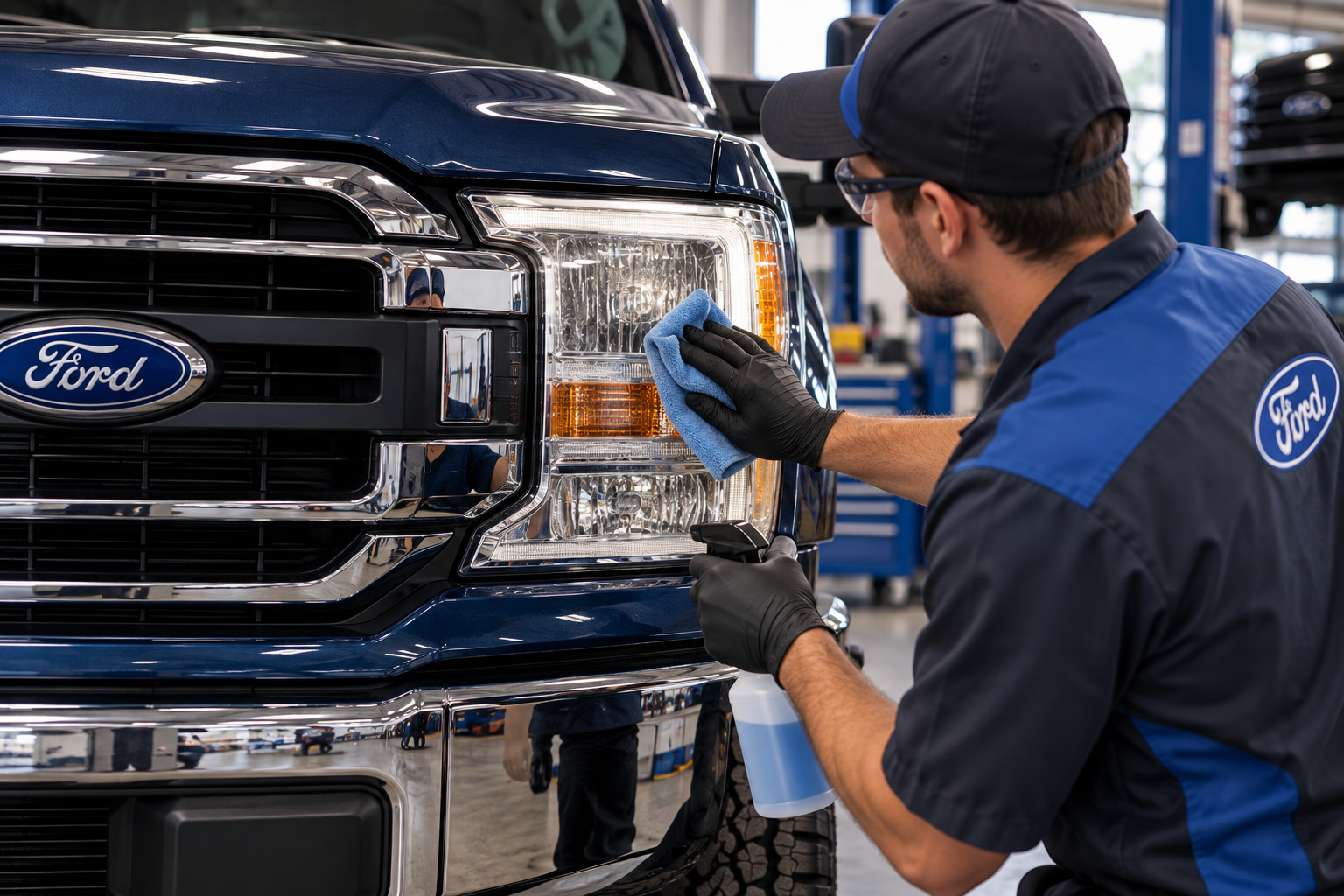
Foggy, cloudy, or yellowed headlights are one of the most common issues Ford owners face as their vehicles age. Cloudy headlights reduce your visibility significantly and make your Ford look older than it actually is. Here is your complete guide to how to clean cloudy headlights and when to consider professional headlight restoration near the Tri-Cities, WA at Speck Ford of Prosser. Why Do Headlights Get Cloudy? Most modern Ford headlight lenses are made from polycarbonate plastic rather than glass. The Yakima Valley receives over 300 days of sunshine per year making UV damage to headlight lenses especially common for Eastern Washington Ford owners. Here is why headlights get cloudy over time: UV Oxidation Most headlight lenses have a factory UV protective coating that degrades over time from constant sun exposure. Once that coating is gone, the lens surface begins to oxidize and turn yellow, cloudy, and hazy. Road Debris and Scratching Rocks, gravel, and sand scratch and pit your headlight lens surface over time. Yakima Valley drivers who regularly travel gravel roads around Prosser and Sunnyside are especially susceptible to road debris damage. Why Clean Headlights Matter Cloudy headlights can reduce your headlight output by up to 80 percent compared to new clear lenses. Shorter fall and winter days in the Tri-Cities mean more driving in the dark every single day. Kennewick, Richland, and Pasco commuters who drive home after work in the dark need every bit of headlight output available. Headlight restoration is a safety issue as much as it is a cosmetic one. Steps for Cleaning Foggy Headlights What You Will Need: Headlight restoration kit including sandpaper, polishing compound, and UV sealant Masking tape to protect surrounding paint Clean microfiber cloths and spray bottle with water Car wash soap, gloves, and eye protection Step 1: Wash and Dry Your Headlights Wash your headlight lenses thoroughly with car wash soap and water. Remove all surface dirt and debris before beginning the restoration process. Dry completely with a clean microfiber cloth before moving forward. Step 2: Mask Off the Surrounding Paint Apply masking tape carefully around the entire perimeter of each headlight lens. Cover all painted body panels and trim adjacent to the headlight housing. This protects your Ford's paint finish from accidental scratching during sanding and polishing. Step 3: Wet Sand the Lens Surface Wet sand the headlight lens starting with the coarsest sandpaper in your restoration kit. Keep the lens and sandpaper wet throughout the entire sanding process. Progress through finer grits until the lens surface appears uniformly hazy and scratch-free. Step 4: Apply Polishing Compound Work the polishing compound into the lens using firm circular motions across the entire surface. Continue polishing until the lens begins to clear and hazy sanding marks disappear. Wipe away compound residue with a clean microfiber cloth. Step 5: Apply UV Sealant This is the most important step that many DIY guides skip entirely. Apply the UV sealant included in your restoration kit to both headlight lenses. Without UV sealant, your headlights will begin to yellow and cloud again within a few months of restoration. Step 6: Remove Masking Tape and Inspect Carefully remove the masking tape after the UV sealant has fully dried. Your headlights should now appear noticeably clearer and brighter than before the restoration process. Tips to Keep Headlights Clear Here are our top tips for how to keep headlights from yellowing after restoration: Park in a garage or shaded area whenever possible to reduce UV exposure Apply a quality UV protectant to your headlight lenses every six months Wash your headlight lenses regularly during routine car washes Avoid harsh chemical cleaners that degrade the UV protective coating faster Apply a coat of car wax to your headlight lenses after washing for added protection When to Replace Your Headlights Sometimes headlight restoration is not enough and headlight replacement is the right solution. Consider headlight replacement in Prosser, WA when: The lens has deep cracks, chips, or physical damage that cannot be polished out Water or moisture is visible inside the headlight housing causing internal fogging Headlight restoration has been performed multiple times with diminishing results Your headlight output is still significantly reduced even after a thorough restoration Our service team at Speck Ford of Prosser will honestly evaluate your headlights and recommend restoration or replacement based on your actual lens condition. Professional Headlight Restoration vs DIY Professional headlight restoration near the Tri-Cities, WA at Speck Ford offers several advantages over DIY kits: Professional-grade equipment produces better and longer-lasting results Our team applies a superior UV coating that lasts significantly longer than DIY kits Our certified technicians identify whether restoration or headlight replacement is the better option Professional restoration uses Genuine Ford OEM replacement parts if replacement is needed Schedule Your Headlight Service at Speck Ford of Prosser Ready to schedule your headlight restoration near the Tri-Cities, WA or headlight replacement in Prosser, WA? Here is how to book your appointment: Online: Visit our website and click "Schedule Service" By Phone: Call our service department directly Walk-In: Stop by during service hours for same-day headlight inspection Do not drive through fall and winter Yakima Valley nights with cloudy headlights. Schedule your headlight restoration at Speck Ford of Prosser today and see the road more clearly on every drive. Schedule Service The information provided is for general informational purposes only and does not constitute legal, financial, or professional advice. While we strive to provide accurate and up-to-date information, we make no guarantees regarding the completeness, accuracy, or reliability of the information presented. Any action you take based on the context of this blog is strictly at your own risk. Always consult a qualified professional or specialist for advice specific to your situation. We are not responsible for any losses or damages arising from the use of this blog or its content.
uneven-tire-wear-on-a-f150

What Causes Uneven Tire Wear on a Ford F-150?

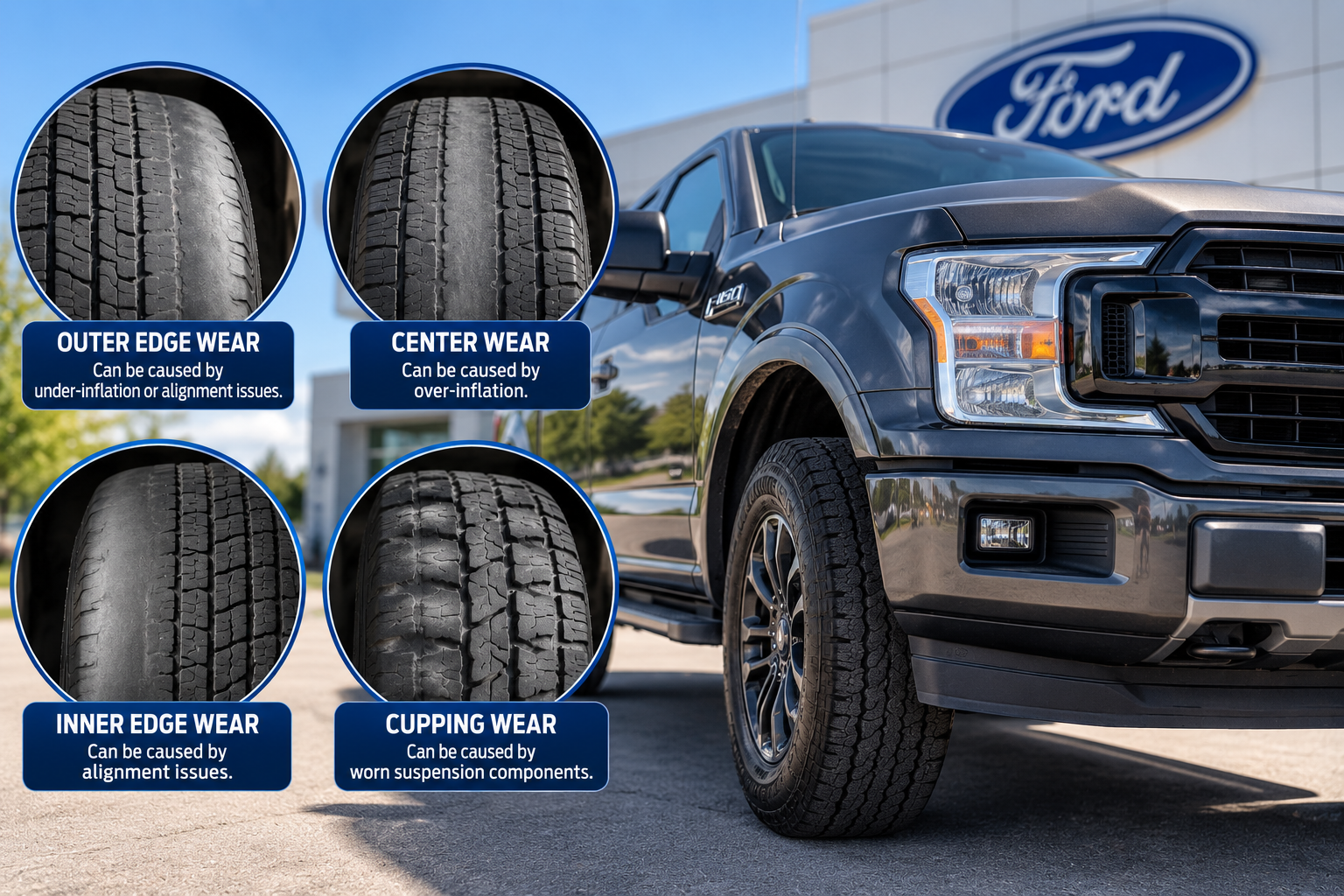
Uneven tire wear is one of the most common and most costly maintenance issues Yakima Valley F-150 owners face. Catching F-150 uneven tire wear early can save you hundreds of dollars on premature tire replacement. Here is your complete guide to what causes uneven tire wear, how to read tire wear patterns, and how to get professional tire service in Prosser at Speck Ford of Prosser. Why Uneven Tire Wear Matters Your tires are the only contact point between your F-150 and the road surface. Uneven tire wear reduces traction, handling, braking performance, and fuel economy significantly. It also dramatically shortens the overall life of your tires leading to premature and costly replacement. Addressing F-150 uneven tire wear early almost always means a less expensive repair than waiting until the problem becomes severe. Tire Wear Pattern Guide Wear Pattern What It Looks Like Most Likely Cause Center Wear Worn in middle, good on edges Overinflated tires Edge Wear Worn on both outer edges Underinflated tires Inner Tire Wear Worn heavily on inside edge Negative camber or alignment issue Outer Edge Wear Worn heavily on outside edge Positive camber or alignment issue Feathering Smooth on one side, sharp on other Toe alignment out of specification Cupping/Scalloping Dips or cups around tread Worn shocks or struts Patchy Wear Uneven patches around tire Tire balance issue or flat spot Common Causes of Uneven Tire Wear on a Ford F-150 Incorrect Tire Pressure Incorrect tire pressure is the single most common cause of uneven tire wear on any vehicle. Overinflated tires wear faster in the center of the tread. Underinflated tires wear faster on both outer edges. Always check your F-150's tire pressure when tires are cold and inflate to the recommended PSI on your door jamb sticker. Wheel Alignment Issues Wheel alignment problems are one of the most common causes of inner tire wear and outer edge wear on the F-150. When your wheels are not pointing in the correct direction, the tire scrubs against the road at an angle. Yakima Valley drivers who regularly travel rural roads or hit potholes on US-12 are especially susceptible to alignment issues. Tire Imbalance Unbalanced tires cause the wheel assembly to vibrate during driving creating cupping or scalloping wear patterns. Tire balancing should be performed every time new tires are installed and rechecked at regular intervals. Our tire service in Prosser at Speck Ford includes professional tire balancing on every rotation visit. Worn Shocks or Struts Worn shocks or struts allow your tires to bounce and hop during driving creating cupping wear patterns on your tires. If your F-150 has significant mileage and you notice cupping wear, have your shocks and struts inspected right away. Infrequent Tire Rotations Front and rear tires on your F-150 wear at different rates due to different driving forces on each axle. Most Ford service professionals recommend rotating your F-150's tires every 5,000 to 7,500 miles. Our tire service in Prosser at Speck Ford can handle your rotation during your next oil change visit. Signs You Should Have Your Tires Checked Your F-150 pulls to the left or right on a straight road You notice visible tire wear patterns that look uneven across the tread You feel vibration through the steering wheel at highway speeds on I-82 or US-395 Your ride feels rougher or bouncier than it used to on Yakima Valley roads You hear unusual humming or roaring noises from your tires during normal driving Your front tires are wearing noticeably faster than your rear tires between rotations How to Check Your Tire Tread Depth The Quarter Test Insert a quarter into your tread groove with Washington's head pointing down. If you can see the top of Washington's head, your tread is at or below 4/32 inch and replacement should be considered soon. The Penny Test Insert a penny into your tread groove with Lincoln's head pointing down. If you can see the top of Lincoln's head, your tread is at or below 2/32 inch. That is the legal minimum in Washington State and means immediate replacement is needed. Tread Depth Reference Guide Tread Depth Condition Recommendation 6/32 inch or more Good Continue regular maintenance 4/32 inch Fair Plan for replacement soon 2/32 inch Worn Replace immediately Below 2/32 inch Unsafe Do not drive on these tires How to Prevent Uneven Tire Wear on Your F-150 Check and adjust tire pressure at least once a month and before every road trip Rotate your tires every 5,000 to 7,500 miles or at every oil change visit Have your wheel alignment checked at least once a year or after any significant impact Have your tire balancing checked at every tire rotation and when installing new tires Inspect shocks, struts, ball joints, and tie rods at every major service interval Check your tires visually for unusual tire wear patterns at least once a month Get Professional Tire Service in Prosser at Speck Ford Ready to schedule your tire service in Prosser or alignment in Prosser at Speck Ford of Prosser? Our certified technicians use professional-grade equipment to diagnose and correct F-150 uneven tire wear quickly and accurately. Here is how to schedule your appointment: Online: Visit our website and click "Schedule Service" By Phone: Call our service department directly Walk-In: Stop by during service hours for same-day tire inspection Do not ignore uneven tire wear on your F-150. Schedule your tire service in Prosser at Speck Ford today and keep your truck performing safely on Yakima Valley roads. Schedule Service The information provided is for general informational purposes only and does not constitute legal, financial, or professional advice. While we strive to provide accurate and up-to-date information, we make no guarantees regarding the completeness, accuracy, or reliability of the information presented. Any action you take based on the context of this blog is strictly at your own risk. Always consult a qualified professional or specialist for advice specific to your situation. We are not responsible for any losses or damages arising from the use of this blog or its content.

wipers-being-replaced

How Often Should You Replace Windshield Wipers? A Guide for Yakima Valley Drivers

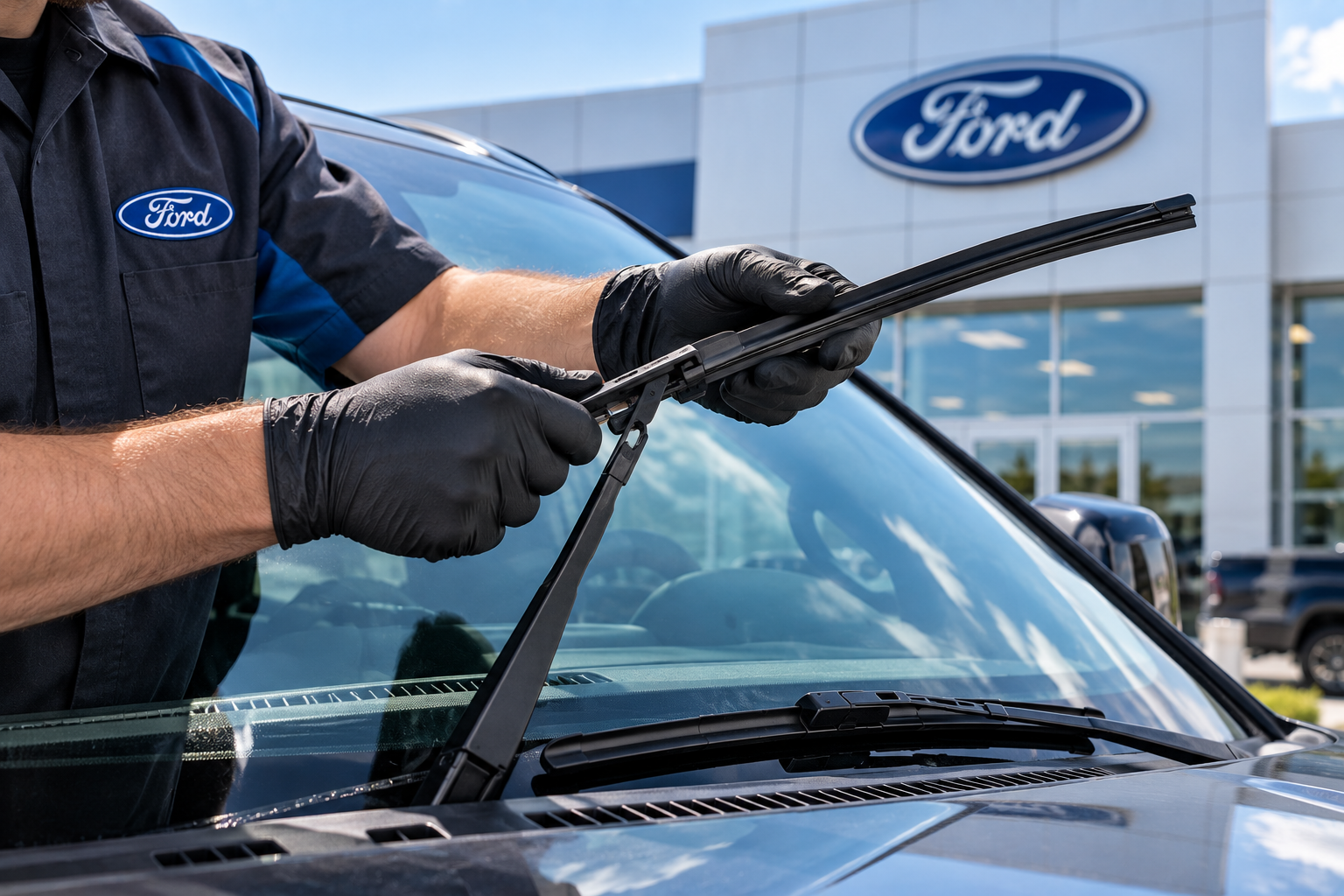
Windshield wipers are one of the most overlooked maintenance items on any vehicle today. Most drivers do not think about their wipers until they stop working in the middle of a rainstorm. Here is your complete guide to windshield wiper replacement for Yakima Valley and Tri-Cities Ford drivers. 6 Signs It Is Time for New Wiper Blades 1. Streaking If your wipers leave streaks across your windshield instead of clearing it cleanly, the rubber blade has worn and hardened. Streaking is the most common sign of bad wiper blades and significantly reduces visibility during rain. 2. Skipping If your wiper blades skip or chatter across your windshield, the blade has developed a curvature from sitting in a set position. Skipping blades leave large unwiped sections that reduce visibility dangerously during heavy rain. 3. Smearing Smearing occurs when your wipers push water around the windshield instead of clearing it effectively. This is often a sign the rubber blade has cracked or become contaminated with road grime and wax buildup. 4. Squeaking If your wiper blades produce a loud squeaking sound during operation, the rubber has hardened and is dragging across the glass. Squeaking blades are a clear sign your new wiper blades are overdue. 5. Visible Damage or Cracking Visually inspect your wiper blades regularly for cracks, tears, or chunks missing from the rubber edge. Any visible damage means it is time for immediate windshield wiper replacement. 6. Reduced Visibility in Rain If you find yourself leaning forward to see clearly during rain, your wiper blades are no longer performing adequately. Do not wait to replace your wipers if your visibility in rain has decreased noticeably. How Often Should You Replace Your Wipers? Most service professionals recommend replacing wiper blades every 6 to 12 months Always replace your wipers at the first sign of reduced performance or visibility Replace your wipers before fall rain season arrives in the Yakima Valley each year Check your wiper blades during every oil change visit at Speck Ford of Prosser Why the Yakima Valley Is Tough on Wiper Blades Extreme Summer Heat Eastern Washington summers regularly push temperatures into the 90s and 100s across the Yakima Valley. That extreme heat causes wiper blade rubber to harden, crack, and deteriorate faster than in milder climates. UV Exposure The Yakima Valley receives over 300 days of sunshine per year making UV exposure a significant factor in wiper blade deterioration. UV radiation breaks down the rubber compounds in your wiper blades over time. Agricultural Dust Eastern Washington's agricultural environment coats everything in fine dust during dry summer months. That dust accumulates on your wiper blades and acts as an abrasive that accelerates rubber wear over time. Fall Rain After Dry Summers Yakima Valley fall rain arrives after months of dry conditions leaving roads covered in built-up oils and debris. Wiper blades that have hardened during summer struggle significantly with the first heavy fall rains. Tips to Make Your Wiper Blades Last Longer Lift your wiper blades away from the windshield during extreme summer heat when possible Clean your wiper blades regularly with a damp cloth to remove dust and grime Always use windshield washer fluid when running your wipers to reduce friction Never run your wipers on a dry windshield as it accelerates rubber wear significantly Remove ice and snow from your windshield before running your wipers in winter Park in the shade whenever possible during Yakima Valley's intense summer months Do Not Forget the Rear Wiper Many Ford owners focus only on the front wiper blades and completely forget about the rear wiper. Your rear wiper is just as important for visibility and safety as your front blades. Check your rear wiper blade condition at the same time as your front blades and replace it on the same schedule. Why Choose Genuine Ford Wiper Blades? Engineered for Your Ford Genuine Ford wiper blades are designed specifically for your Ford model's windshield curvature and wiper system. That precise fit ensures optimal contact across the entire wipe pattern for maximum visibility. Superior Rubber Compound Genuine Ford wiper blades use a premium rubber compound that resists hardening in extreme heat and UV exposure. That superior rubber is especially important for Yakima Valley drivers who deal with intense summer conditions every year. Correct Fit Every Time Generic wiper blades purchased at retail stores may not fit your specific Ford model correctly. Genuine Ford wiper blades fit your vehicle perfectly every single time without any guesswork. Get New Wiper Blades at Speck Ford of Prosser Ready to get new wiper blades at Speck Ford of Prosser? Windshield wiper replacement is one of the quickest and most affordable service items available at our dealership. Here is how to schedule your wiper blade replacement today: Online: Visit our website and click "Schedule Service" By Phone: Call our service department directly Walk-In: Stop by during service hours for same-day wiper blade replacement Do not wait until a fall rainstorm on US-12 or I-82 to discover your wiper blades are failing. Schedule your windshield wiper replacement at Speck Ford of Prosser today. Schedule Service